StoryLatch
AI Workflow Prototype for Editorial Decision Support
StoryLatch is an AI-assisted newsroom decision-support system designed to improve story discovery, reduce editorial busywork, and preserve human authority.
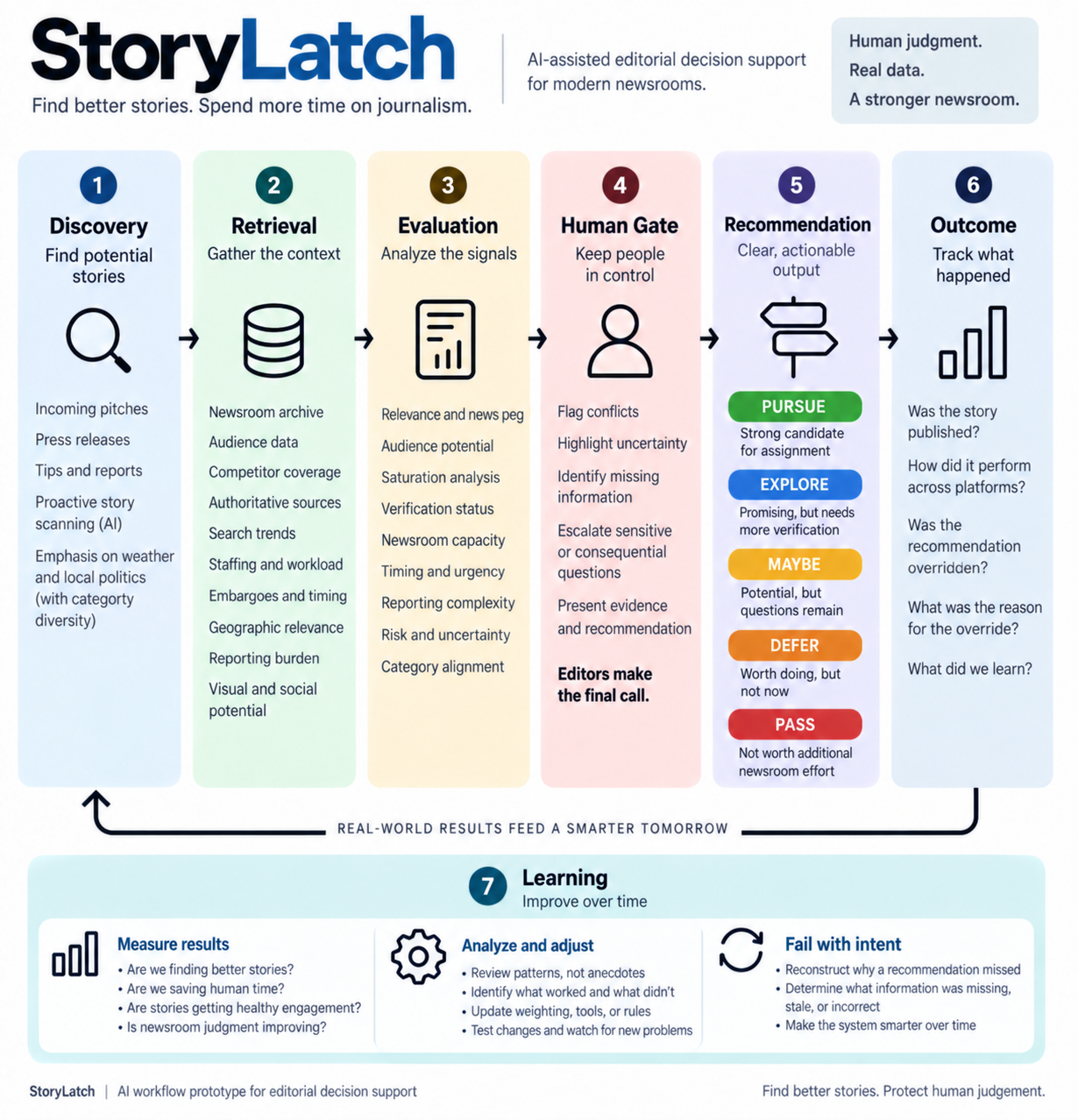
StoryLatch workflow: Discovery → Retrieval → Evaluation → Human Gate → Recommendation → Outcome → Learning
The Problem
Digital newsrooms spend a lot of time doing things that happen before the actual journalism: finding stories, checking previous coverage, reviewing audience performance, comparing competitors, doing preliminary verification, and deciding whether something is worth assigning.
That work matters, but it can eat into the time producers and editors should be spending writing, editing, and publishing.
I designed StoryLatch as a reliable first-pass editorial layer: surfacing promising stories, organizing the evidence around them, and making a recommendation while keeping the final decision in human hands.
How StoryLatch Works
StoryLatch can begin with an incoming pitch, press release, report, or announcement — or it can proactively surface story candidates when the newsroom needs ideas.
From there, the system moves through a structured workflow:
Discovery → Retrieval → Evaluation → Human Gate → Recommendation → Outcome → Learning
At each stage, StoryLatch gathers evidence, evaluates newsroom context, and decides whether it can continue automatically or needs human judgment.
Design Principles
StoryLatch is built to support editorial judgment without quietly taking control of it.
Human authority
StoryLatch can recommend, but humans make consequential editorial decisions.
Evidence first
Research is meant to test a story, not prove the answer the system wants.
Bounded research
Preliminary verification has limits so the system doesn’t spin endlessly.
Least privilege
Read-only access to newsroom systems wherever possible.
Conflict escalation
When credible sources disagree on a central fact, StoryLatch surfaces the conflict instead of resolving it.
Learn from patterns
Overrides and outcomes are reviewed in batches before changing system behavior.
What StoryLatch Looks At
Story relevance — Local, statewide, or national with a meaningful Texas connection.
Audience signals — Historical performance and search interest.
Competitive coverage — Saturation, duplication, and what’s actually new.
Verification — Source quality, fact-checking, and conflicting claims.
Newsroom capacity — Staffing, current assignments, and breaking-news load.
Timing — Freshness, embargoes, urgency, and whether the story can hold.
Reporting burden — Time, complexity, and cost of uncertainty.
Visual/social potential — Whether the story has strong visual value for social treatment.
How I’d Measure Success
Are we finding better stories?
Are we saving meaningful human time?
Are StoryLatch-assisted stories getting healthy engagement?
Is the collective quality of newsroom judgment improving?
The goal isn’t perfection. It’s a system that saves time, improves decisions, and makes its misses useful enough to learn from.
What I Learned
The biggest lesson was that AI system design is not primarily technical. It is logical.
The real work is understanding the process deeply enough to define the inputs, rules, exceptions, human gates, and feedback loops.
StoryLatch helped me turn years of editorial judgment into a repeatable AI-assisted workflow without giving away the human authority that made that judgment valuable.
Prototype / system design case study